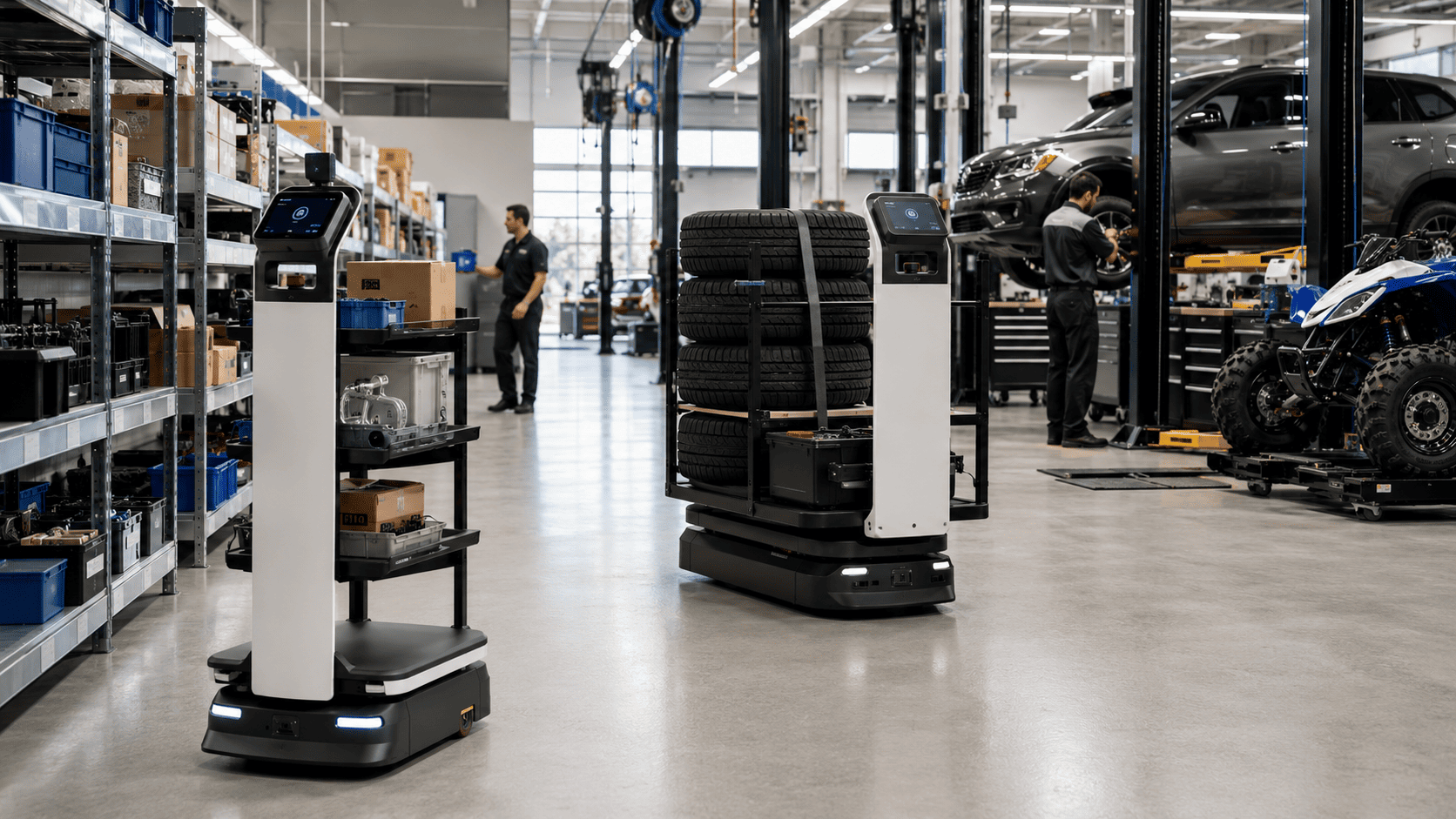
Automotive shop automation can help dealerships and powersports businesses reduce repeated walking, parts delays, and manual cart movement. Autonomous mobile robots (AMRs) can transport parts, tires, batteries, tools, and supplies between departments while technicians and parts employees stay focused on higher-value work.
When this movement is smooth, the shop runs better. Technicians can stay focused on repairs, installations, inspections, and service work. Parts employees can support customers, manage inventory, and help the service team without constantly walking back and forth.
When material movement is not smooth, the entire operation can slow down. Technicians may wait for parts. Employees may spend too much time pushing carts. Parts may sit in the wrong place. Service jobs may take longer than expected. Customers may wait longer for their vehicles, motorcycles, ATVs, UTVs, or equipment to be completed.
For many shops, the problem is not the quality of the team. The problem is the amount of time spent moving materials manually.
That is where automation can help.
Autonomous mobile robots, also called AMRs, can support automotive and powersports businesses by moving parts, tools, tires, supplies, bins, and inventory through the facility with less manual effort. The goal is not to automate everything at once. The goal is to find the repetitive movement that slows down your team and improve that workflow first.
What Material Movement Means in a Shop
Material movement is the daily process of moving items from one area to another inside your business. In an automotive dealership, this may include moving parts from the parts counter to service bays, transporting tires from storage to the mounting area, or returning unused parts and cores back to the parts department.
In a powersports facility, material movement may include motorcycle parts, ATV parts, UTV parts, marine parts, batteries, accessories, boxed components, and P&A items moving between storage, service, installation, and retail areas.
These tasks may seem small by themselves, but they happen many times a day. Every extra trip, delay, or misplaced item adds time to the workflow. Over a full day or week, that lost time can become a real cost.
1. Technicians Are Waiting for Parts, Tools, or Supplies
technicians regularly stop working because they are waiting for parts, tires, batteries, tools, fluids, or supplies, your shop may be losing valuable labor time.
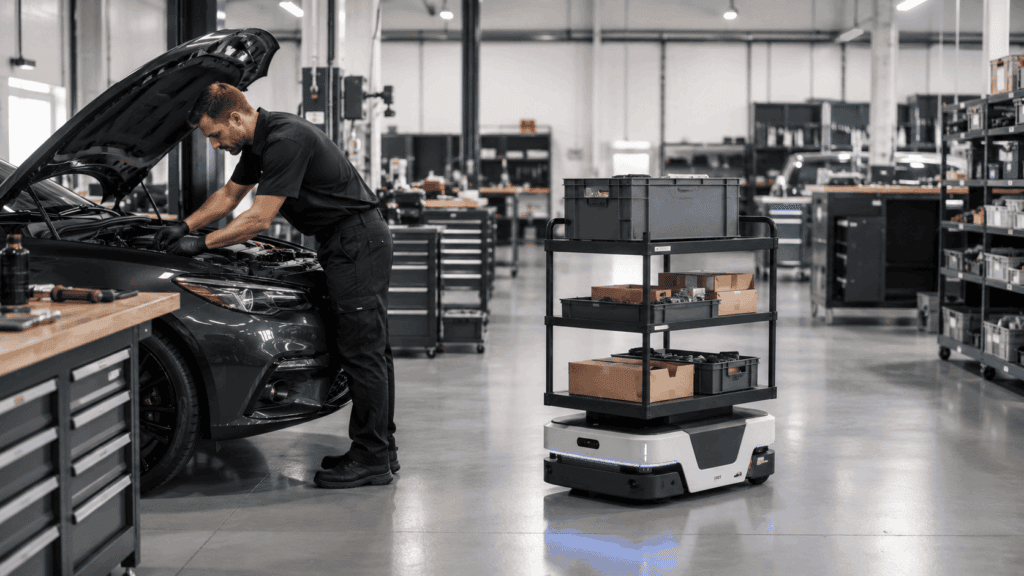
This often happens when the parts department is busy, the warehouse is far from the service area, or employees are already handling too many delivery trips during the day. An AMR can help support this workflow by moving parts and supplies from the parts counter, warehouse, or staging area to the service bays.
The goal is simple: keep technicians focused on service, repair, installation, and inspection work instead of waiting for materials to arrive.
2. Employees Spend Too Much Time Walking or Pushing Carts
Parts employees, warehouse staff, and service team members already have important work to do. When they spend too much of the day walking across the shop, pushing carts, delivering items, returning cores, or moving supplies, the whole operation can slow down.
In an automotive dealership, this may include repeated trips between the parts counter, warehouse, service bays, tire storage, and receiving area. In a powersports facility, it may include moving motorcycle parts, ATV parts, UTV parts, marine parts, batteries, accessories, and boxed components between storage, service, and installation areas.
If your team is making the same trips many times a day, that repeated movement may be a good opportunity for AMR automation.
3. Heavy or Awkward Materials Are Slowing Down the Workflow
Some materials are harder to move than others. Tires, wheels, batteries, fluids, boxed parts, tools, and shop supplies can be heavy, awkward, or time-consuming to transport.
When employees have to move these items manually, it can create delays and increase physical strain. It may also require multiple trips or extra help from another employee.
AMRs can help create a more consistent way to move these materials when the load, route, and carrying platform are planned correctly. This can help reduce unnecessary lifting, pushing, and carrying while keeping materials moving through the shop.
4. Busy Seasons Create Material Movement Bottlenecks
Automotive and powersports businesses often experience busy periods. Tire season, battery replacement, fleet service, maintenance campaigns, and promotional service events can increase material movement inside an automotive shop.
Powersports businesses may feel this even more during peak riding, boating, or outdoor seasons. When demand increases for motorcycles, ATVs, UTVs, personal watercraft, marine products, accessories, parts, and service work, the same team may need to move more materials in less time.
If busy seasons lead to longer waits, more misplaced parts, crowded storage areas, and repeated trips between departments, automation may help your facility handle growth more smoothly.
5. Parts, Supplies, and Inventory Are Not Moving in a Clear Process
Material movement is not only about speed. It is also about organization.
When parts, tools, accessories, cores, or supplies move through the shop without a clear process, they can end up in the wrong place. Employees may spend time searching for items, checking with other departments, or delaying service work because materials are not where they should be.
AMRs can help support a more organized movement process when combined with clear staging areas, labels, employee procedures, and inventory systems. The robot does not solve every workflow issue by itself, but it can help create a more consistent way to move materials between departments.
What Should You Automate First?
The best first automation project is usually simple, repeated, and easy to measure.
For many automotive dealerships, the best starting point may be parts delivery from the parts counter to the service bays. For tire operations, it may be moving tires from storage to the mounting area. For powersports facilities, it may be moving accessories, batteries, boxed parts, or components from storage to service or installation areas.
The key is to start with one clear workflow. Do not try to automate the entire shop at once. A focused first project makes it easier to test the process, train employees, measure results, and improve the system before expanding to other areas.
What Should You Measure Before Automating?
Before adding automation, take time to understand your current process. Look at how often employees move materials, how long each trip takes, where delays happen, and how often technicians wait for parts or supplies.
It is also helpful to track how many employee hours are spent on material movement, how often parts are misplaced, and which routes are repeated most often. These numbers help determine whether automation is worth considering and give you a way to measure improvement after the AMR is introduced.
How Automotive Shop Automation Helps Automotive and Powersports Businesses
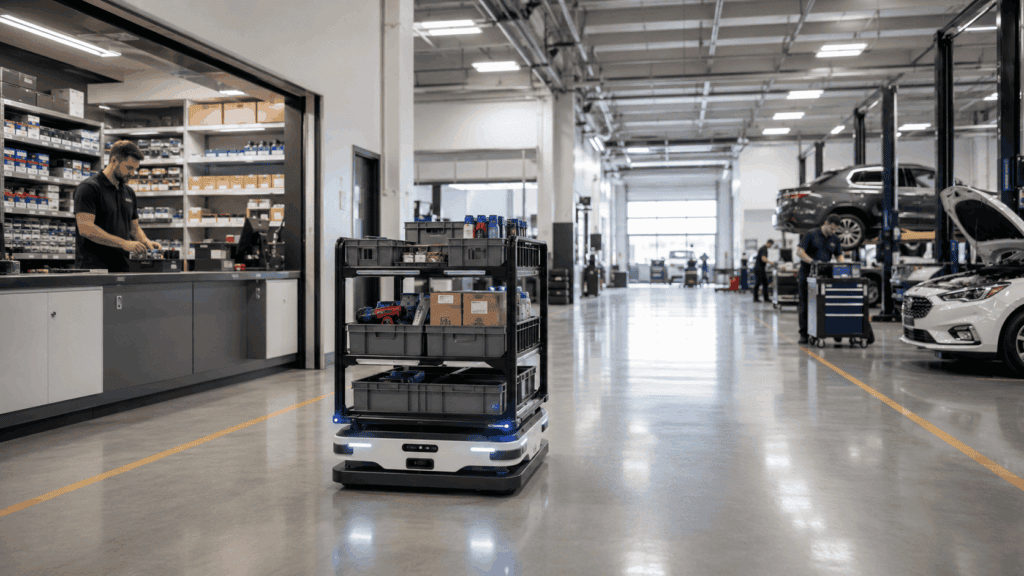
AMRs can help move materials more consistently through the facility. Depending on the workflow, they may support parts delivery, tire movement, battery transport, tool delivery, supply runs, warehouse-to-service movement, receiving, storage, picking, or returns.
The biggest benefit is not simply having a robot in the shop. The real value is improving how work moves through the business. When materials move better, technicians wait less, employees walk less, and the shop can operate with a smoother daily rhythm.
Material movement is one of the hidden time costs in automotive and powersports operations.
Every trip to pick up a part, every cart pushed across the shop, every technician waiting for supplies, and every misplaced item adds time to the day. When this happens often, it may be time to look at automation.
AMR automation can help shops move parts, tools, tires, batteries, accessories, supplies, and inventory more efficiently. It can also help employees focus on the work that matters most.
The best place to start is by looking at where your team spends the most time walking, carrying, pushing, waiting, or searching. That is often where material movement automation can make the biggest difference.
ShopProBot helps automotive, powersports, warehouse, and service operations explore practical AMR solutions for real-world material movement. Whether your goal is to reduce walking time, improve service flow, support technicians, or prepare for future growth, the right AMR workflow can help your business move smarter.
Common AMR Concerns (And Why They’re Not a Problem)
1. What is material movement in an automotive or powersports shop?
2. How do I know when to automate material movement?
3. What should an automotive shop automate first?
4. What should a powersports business automate first?
5. Can AMRs work around technicians and service bays?
6. Do AMRs replace shop employees?
7. How can AMRs improve shop efficiency?
8. What should I check before adding an AMR?
Want to see how AMRs could fit into your operation? Let’s explore the possibilities together.
Contact our team: sales@shopprobot.com