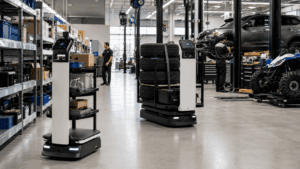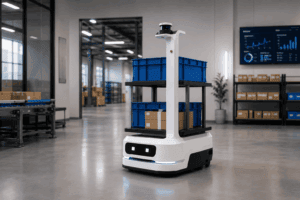
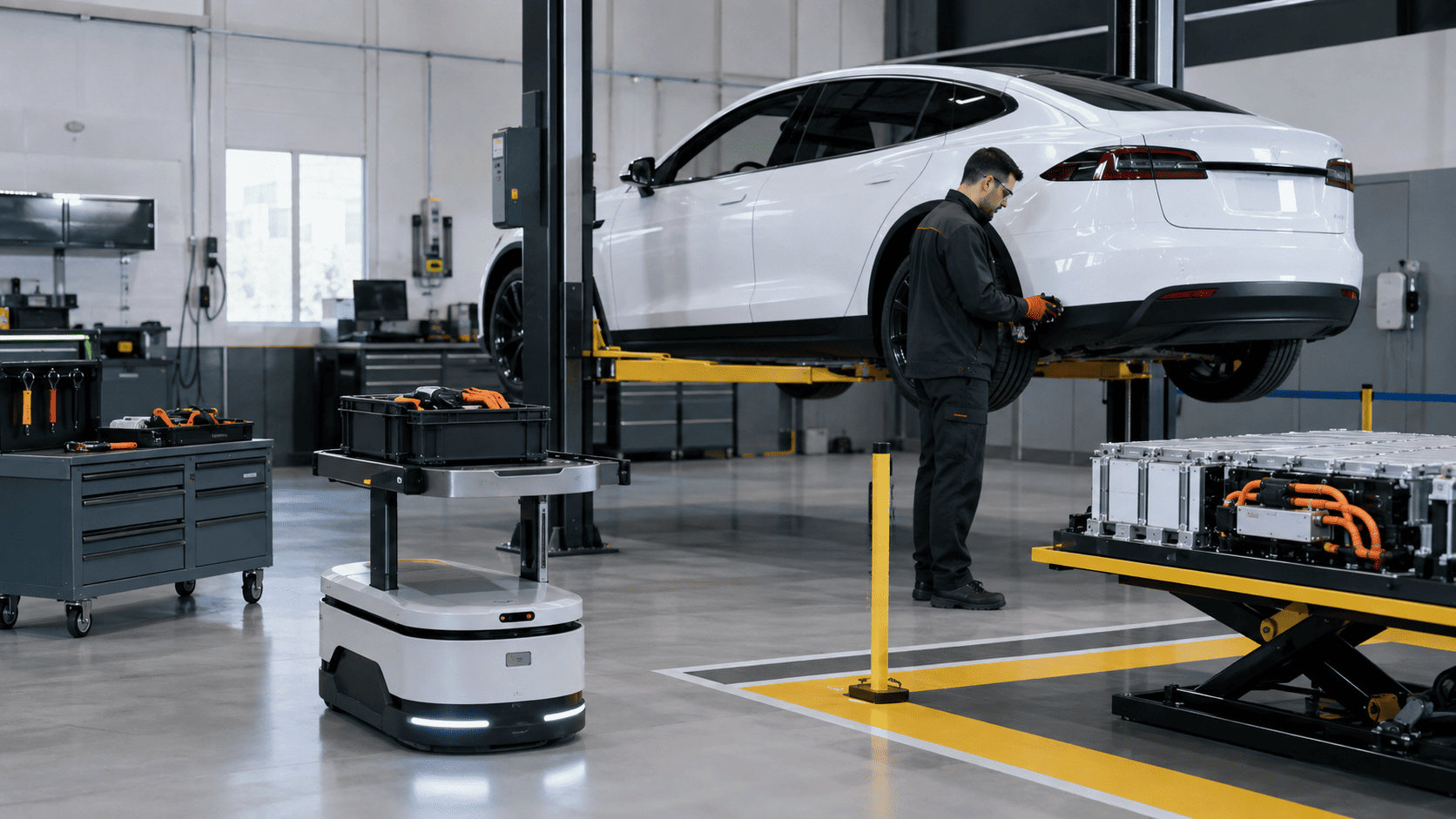
A mobile robot can deliver tools, parts, PPE, and supplies between established locations while trained technicians remain responsible for high-voltage safety, diagnostics, battery handling, and repairs.
Preparing an automotive shop for electric and hybrid vehicle service requires more than adding a battery cart or buying new diagnostic equipment. EV readiness depends on how technicians, vehicles, tools, replacement parts, and removed components move through the facility from the time a vehicle arrives until the repair is complete.
Automation can support that process, but it should be treated as one part of a larger workflow. It does not replace trained technicians, high-voltage safety procedures, current vehicle-specific service information, or properly rated lifting and handling equipment.
For shops evaluating EV repair shop equipment, the best place to begin is with the full service process. Once the work area, battery-handling plan, storage locations, charging needs, diagnostic procedures, and technician responsibilities are clear, automation can help reduce unnecessary travel and keep routine material movement organized.
High-voltage safety comes first
High-voltage safety is the foundation of any EV or hybrid service operation. Only trained and authorized personnel should inspect, isolate, test, remove, or install high-voltage components.
Before work begins, technicians need current vehicle manufacturer procedures for isolation points, required waiting periods, verification steps, lifting locations, battery support points, and component removal. They also need the correct PPE, insulated tools, and electrical test equipment.
Automation does not make these safety decisions. Its role is simpler: it can bring approved tools, warning devices, PPE, or replacement parts to a designated point near the controlled work area. Responsibility for system isolation, battery condition assessment, and repair execution stays with qualified people.
Set up a controlled EV work area
An EV service bay should be stable, clearly marked, and free of unnecessary congestion. The floor should be hard and level, with enough room for the vehicle, technicians, battery carts, powertrain lifts, diagnostic tools, and emergency access.
The shop should decide where PPE, insulated tools, warning barriers, service carts, replacement parts, and removed components will be kept. Those fixed locations also make automated delivery easier because the robot (AMRs) has clear pickup and drop-off points.
Automation works best in a shop where the workflow is already organized. If tools and parts are stored wherever space happens to be available, consistent delivery routes will be difficult to maintain.
Plan battery and powertrain handling first
EV battery service equipment must be selected for the actual component being handled. Before a battery is removed, technicians should confirm its weight, dimensions, center of gravity, support points, balance, and the vehicle manufacturer’s procedure.
Large underbody packs usually require a stable battery-handling cart for removal, lowering, transport, and staging. Electric drive units, engines, transmissions, fuel tanks, and other heavy assemblies may require a powertrain lift with the right capacity, table size, adapters, mobility, and height range.
These devices serve a different purpose from an autonomous mobile robot. A battery cart or powertrain lift supports and positions heavy components. A mobile robot is better suited to moving smaller tools, parts bins, supplies, and other approved loads between fixed locations.
Reduce unnecessary technician travel
One of the clearest uses for automation in a hybrid service shop is the repeated movement of materials between the parts department, tool room, storage area, and service bay.
During a typical repair, a technician may leave the bay several times to collect fasteners, adapters, replacement parts, PPE, diagnostic accessories, documentation, or shop supplies. Each trip is small, but repeated walking interrupts the job and keeps the technician away from the vehicle.
An autonomous mobile robot can follow a repeatable indoor route and deliver approved items to a nearby drop-off point. The technician can stay focused on the service procedure instead of making routine trips across the shop.
Support a cleaner work zone
Clean and open work zones matter during EV battery, electrical, cooling-system, and powertrain service. Loose packaging, unused tools, cables, and extra carts can make it harder to position handling equipment and may block travel or emergency routes.
Instead of placing every part in the bay at the beginning of the repair, a shop can stage materials elsewhere and deliver them as needed. This helps separate new components from removed components, clean tools from used tools, and routine parts from anything that may be damaged.
The benefit is not only faster delivery. It is a more predictable and easier-to-manage work area.
Coordinate diagnostics and charging
EV service often requires scan tools, laptops, electrical test equipment, battery-support equipment, and charging access. These items should be positioned so technicians can reach them without creating more congestion around the vehicle.
Automation may help move diagnostic accessories, cables, documentation, or small pieces of test equipment between storage and assigned work locations. Charging capacity, cable management, electrical requirements, and manufacturer procedures still need to be planned separately.
A mobile robot supports the logistics around diagnostics and charging. It does not replace the electrical or technical planning behind them.
Create storage and isolation procedures
A complete EV workflow must account for what happens after a battery, drive unit, or other component is removed. The shop should know where each item will be staged before the repair begins.
Removed batteries should not be left in active travel paths or placed where they could be struck by vehicles, forklifts, carts, or other equipment. Replacement parts should also be kept separate from removed or potentially damaged components.
Vehicles showing signs of collision damage, flooding, overheating, smoke, or unusual odors need a separate response procedure. They should not be treated as part of the normal automated delivery workflow.
Review the facility before deployment
A mobile robot should be evaluated in the shop where it will actually operate. Floor condition, aisle width, vehicle and pedestrian traffic, loading points, delivery locations, payloads, and the planned docking area all matter.
The route should be tested during normal activity. Open toolboxes, parked vehicles, temporary carts, wet floors, and changing traffic can all affect performance.
The ShopProBot JOY6 is designed for repeated indoor delivery tasks and can move parts bins, tools, and supplies between designated locations. A successful deployment depends on matching the robot to the facility and defining a route that fits everyday shop conditions.
Build the process before automating it
Automation is most effective when it supports a process that is already clear. The shop should first decide which EV and hybrid repairs it plans to offer, who is authorized to perform them, and how high-voltage work will be controlled.
From there, the shop can define equipment locations, storage areas, delivery points, and material routes. Once the workflow is stable, repeated movements that do not require technical judgment can be considered for automation.
A robot cannot fix an unclear process. It can make a well-organized process more consistent.
| Build a more efficient EV service workflow Preparing for EV and hybrid service takes more than one piece of equipment. Explore EV service equipment or consult with K&L Supply about battery handling, powertrain service, and material-flow automation. |
Frequently asked questions
1. Can automation perform high-voltage EV service?
No. High-voltage isolation, testing, diagnostics, battery removal, and repairs should be completed by properly trained and authorized technicians. Automation can support the movement of tools, parts, and supplies around those activities.
2. What can a mobile robot move in an EV repair shop?
A mobile robot may transport approved parts, small tools, PPE, documentation, diagnostic accessories, and shop supplies between established indoor locations.
3. Can a mobile robot transport an EV battery?
A general-purpose mobile robot should not replace a battery cart or other handling equipment designed and rated for EV battery removal and transport.
4. How can automation improve EV shop readiness?
Automation can reduce repeated walking, improve parts delivery, limit unnecessary traffic around the service bay, and make material flow more consistent.
5. Should a shop add automation before setting up its EV process?
No. Safety procedures, technician roles, work areas, handling equipment, and storage locations should be established first. Automation can then be added where it offers a clear operational benefit.